
♞Websites
Landing page vs homepage: the differences, where to send ad traffic, and how to structure each
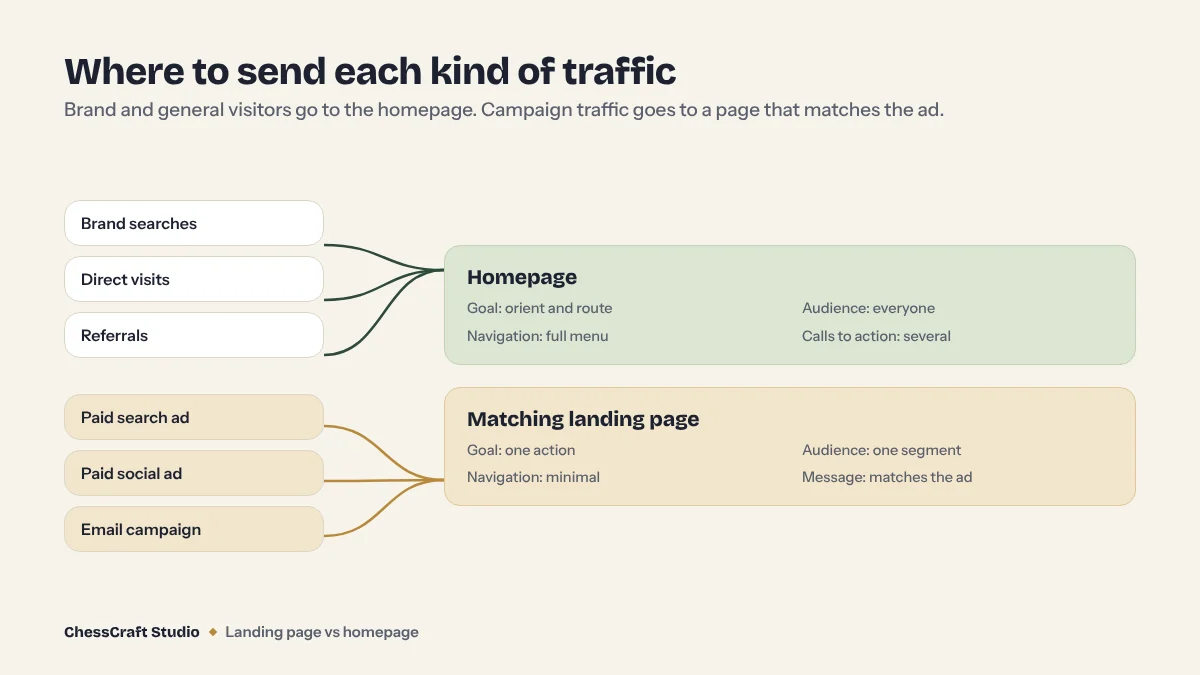
Short answer: A homepage introduces your whole business to every kind of visitor and offers many paths. A landing page has one audience, one offer and one action, with few distractions. Send paid traffic for a specific product, offer or search intent to a matching landing page; send brand searches and general visitors to the homepage.
The homepage is usually the most designed page on a site, so it is tempting to send every ad there. But a visitor who clicked an ad for one product, offer or problem rarely wants a tour of your company. They want proof that they have arrived in the right place, and a clear next step.
This guide explains how the two pages differ, when each is the right destination for ads, and how we structure a landing page so the click is not wasted. If your site needs both rebuilt, our website redesign service covers homepages, landing pages and everything in between.
What is the difference between a landing page and a homepage?
| Area | Homepage | Landing page |
|---|---|---|
| Goal | Orient visitors and route them to the right section | Get one specific action: buy, book, enquire, sign up |
| Audience | Everyone: new, returning, customers, partners, job seekers | One segment, usually from one campaign or keyword group |
| Navigation | Full menu, footer links, many routes | Minimal or none; links that support the action |
| Calls to action | Several, for different needs | One primary action, repeated down the page |
| Message | Broad: what the business does overall | Narrow: one product, offer or problem, matching the ad |
| Traffic source | Direct visits, brand searches, referrals | Paid search, paid social, email campaigns, partner links |
| Search engines | Usually your strongest page for brand searches | Often built for paid traffic; can be indexed or not |
| Lifespan | Long term, updated gradually | Can be permanent or tied to a campaign |
Neither is better. They do different jobs. For an e-commerce brand, a product page or collection page often acts as a landing page already, which is why the line between them can blur.
When should you send ad traffic to a landing page?
- The ad is about one product, service or offer. The page should open with exactly that, not a general welcome.
- You are targeting non-brand search terms, such as a problem or category search, where the visitor does not know you yet.
- You run paid social to cold audiences. These visitors were not searching at all, so the page needs to rebuild the hook from the ad quickly.
- You want clean measurement. A dedicated page with one action makes it far easier to see whether a campaign works.
- You are testing a new offer or message before changing the main site.
When the homepage is the right destination
- Brand search campaigns. Someone searching your business name often wants the homepage or a key section.
- Broad awareness campaigns where the goal is to introduce the brand, not sell one item.
- Very small sites where the homepage already focuses on a single service and one clear action.
Even then, check what the ad promises. If it mentions a specific offer, the homepage needs to show that offer clearly near the top, or visitors will bounce.
What Google says about landing pages for ads
Google Ads gives each keyword a Quality Score from 1 to 10, built from three parts: expected click-through rate, ad relevance and landing page experience. Google describes landing page experience as how relevant and useful your page is to people who click your ad. Google’s Search Ads 360 help adds that it reflects the usefulness and relevance of the information, ease of navigation, the number of links on the page and whether the page meets the expectations set by the ad. Google calls Quality Score a diagnostic tool rather than a performance target, but a page that matches the ad helps on every count.
Google’s destination requirements policy also sets hard rules. Ads can be disapproved if:
- the display URL’s domain does not match the final URL, or the page redirects to a different domain;
- the page does not work on common browsers and devices, or returns errors to Google’s ads crawler;
- Google’s ads crawler cannot access the page;
- the page offers little original content, exists mainly to show ads or only sends visitors elsewhere;
- the page is unnecessarily difficult or frustrating to navigate.
Ad platform policies change. Check the current Google Ads and Meta advertising policies before launching a new campaign or landing page template.
How to structure a landing page that converts
This is the order we start from for most service and product campaigns, then adapt to the offer.
- Headline that matches the ad. Repeat the promise, product name or offer from the ad in the first line. This message match reassures the visitor instantly.
- One-sentence explanation and primary action. What it is, who it is for, and a single clear button. On mobile, the button should be visible without scrolling.
- Hero image or short video showing the product, the result or the service in action. Real visuals beat generic stock.
- Proof close to the top. Review ratings, recognisable client logos, guarantees or certifications, but only ones you can back up.
- Benefits, not features. Three to five short blocks explaining what changes for the customer.
- How it works. Three or four steps, so the action feels low risk.
- Objection handling. Pricing approach, delivery, returns, timelines, or an FAQ block.
- Repeat the action. The same button, same wording, at the end.
- Minimal footer. Contact details, privacy policy and terms, so the page stays trustworthy and policy compliant.
From our projects: before designing a landing page, we place the ad and the page’s first screen side by side. If someone could not tell they belong to the same campaign, with the same words, product and visual style, the page needs reworking before anything else is polished.
Design details that matter
- Speed. Paid visitors are expensive. Compress images, limit scripts and test on a mid-range phone. Our guide to making a small business website faster covers the quick wins.
- Form length. Ask only for what you need to respond. Every extra field is another reason to leave.
- Consistent visuals. The landing page should look like the ad, which is easier when both come from one campaign key visual.
- Remove leaks. Hide the full menu or reduce it to a logo and one link back to the main site.
How to structure a homepage alongside it
The homepage still matters for people who arrive later, search your name or click through from a landing page to learn more. It should say clearly what you do and for whom, show proof, and route each type of visitor to the right place. Our guides on what to put above the fold on a homepage and essential small business website pages cover this in detail.
Should landing pages be indexed by search engines?
It depends on the page. A permanent landing page for a core service can earn organic traffic and should be indexed like any other page. Short-term campaign pages, or several near-duplicate versions made for testing, are often better kept out of search results so they do not compete with your main pages. Whichever you choose, do not block Google’s ads crawler from pages you advertise, or the ads can be disapproved.
Common mistakes
- Sending every ad to the homepage and expecting visitors to find the offer themselves.
- Message mismatch, where the ad promises one thing and the page leads with another.
- Too many actions, such as buy, subscribe, follow and download all competing on one page.
- A landing page that looks like a different company, with new colours, fonts and tone.
- No tracking of the single action the page exists for.
- Forgetting mobile, where most paid social traffic arrives.
Checklist for choosing and building the right page
- Each campaign mapped to its destination: landing page, product page or homepage.
- Landing page headline repeats the ad’s promise or offer.
- One primary action, visible on mobile without scrolling.
- Navigation reduced so the page has few exits.
- Real product or service visuals, consistent with the ad.
- Proof near the top that you can back up.
- Display URL domain matches the final URL, with no cross-domain redirects.
- Page loads quickly on a mid-range phone.
- Contact details, privacy policy and terms linked in the footer.
- Conversion tracking set up for the page’s single action.
- Decision made on whether the page should be indexed.
Questions
Can my homepage be a landing page?
Yes, if it focuses on one audience and one main action, as many single-service sites do. For businesses with several products or audiences, a homepage has to serve everyone, so a dedicated landing page usually matches a specific ad more closely and converts better.
Should I send Google Ads traffic to my homepage?
For brand searches, the homepage is often fine. For product, service or problem searches, send visitors to a page that matches the keyword and ad closely. Google's landing page experience rating rewards pages that are relevant, useful and easy to navigate for the people who click.
Does a landing page need navigation?
Not usually. Most landing pages remove the full menu so visitors focus on one action, keeping a logo, contact details and legal links. Google's ad policies do require that pages are not unnecessarily difficult to navigate, so never make the page confusing or hard to leave.
Is a product page a landing page?
In practice, often yes. For e-commerce brands, a well-built product or collection page has one clear action and matches the ad for that product, which is what a landing page needs. Build a separate landing page when you need a bundle, an offer or a different story.
How many landing pages do I need?
Plan one for each distinct offer, audience or keyword group whose message differs meaningfully. A small business might start with two or three, one per core service or product line, and add more as campaigns and tests show which messages work.