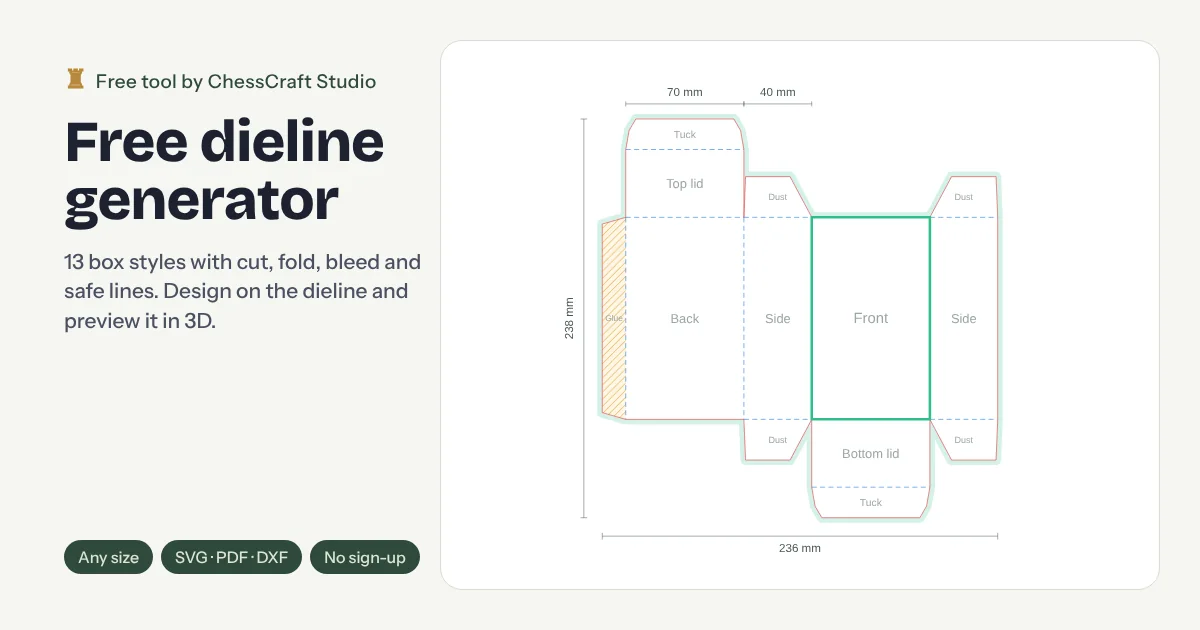
Choose from 13 box styles, enter your inner dimensions and get a print-ready dieline with cut, fold, bleed and safe-area lines. Design your artwork right on the dieline, see it on a 3D box, then download SVG, PDF, DXF or PNG. Free, no sign-up, no credits, and everything runs in your browser.
13 box stylesDesign on the dieline3D preview with your artworkWindow cutoutsSVG · PDF · DXF · PNGPress sheet calculator
4Your dieline
CutFoldBleedSafe
Tip: click any panel on the dieline to design it.
–Flat size (incl. bleed)
–Approx. outer size
–Board area per box
–Inner volume
SVG keeps artwork, cut, fold and bleed on separate layers for Illustrator, Affinity or Figma. PDF has vector cut and fold lines over your artwork. DXF has cut, crease, bleed, safe-area and glue layers for die-makers and cutting tables.
Free print-ready packaging checklist
The 21 checks we run before any packaging goes to print. Get it by email, plus a download link straight away.
5Design on your dieline
Editing
Colours
Image and logo
Panel image
Logo
Text
Orientation is handled for you: lids, walls and flaps are rotated so the design reads correctly once the box is folded. Images never leave your computer.
63D preview
Drag to rotate. Shows the assembled box shape with your design on each face.
7Press sheet calculator
How many blanks fit on one printing sheet, and how many sheets your order needs.
Simple grid with a 10 mm gripper margin. A die-maker can often nest blanks tighter.
Dieline done. Now make it sell.
We design print-ready packaging for brands in the UK, US, UAE and beyond. Send us this dieline and we’ll design the artwork, mockups and print files.
A dieline is the flat cutting and folding plan for a box. This free generator draws one for you: pick one of 13 box styles, enter the inside length, width and height and the board thickness, and download a print-ready PDF, SVG, DXF or PNG with cut, crease, bleed and safe-area lines on separate layers. It runs in your browser with no sign-up.
What you get free
13 box styles, sized from your inside dimensions
Board thickness added to every panel
Cut, crease, bleed, safe area and glue on separate layers
PDF and SVG for Illustrator, DXF for cutting tables, PNG for previews
Design on the dieline and preview it on a 3D box
Press sheet calculator for how many fit on a sheet
Choose your box style. Tuck end boxes suit cosmetics and retail products, mailer and pizza boxes suit e-commerce and food delivery, shipping boxes (RSC) suit cartons, gable boxes carry bakery and gifts, and trays, sleeves and lid-and-base boxes suit premium gift sets.
Measure your product. Enter the inside dimensions, adding 1 to 3 mm of clearance so the product slides in easily.
Pick your board. Thicker board needs slightly larger panels so flaps close neatly. The generator adds this allowance automatically.
Design on the dieline. Click a panel, add a background colour, image, logo or text, and check it on the 3D box.
Download. Send the PDF to your printer, the DXF to your die-maker, or open the SVG in Illustrator, Affinity or Figma to finish the artwork.
A reverse tuck end dieline made with the generator, with cut, fold, bleed and glue areas marked.
13 box styles you can make
Pick a style in the tool above, or open a template that is already set up with typical sizes and board for that box.
Vector cut and fold lines at 1:1 scale over your artwork
SVG
Finishing artwork in Illustrator, Affinity, Figma or Inkscape
Artwork, cut, fold, bleed and safe area on separate layers
DXF
Die-makers, cutting tables and CAD
Cut, crease, bleed, safe-area and glue layers in millimetres
PNG
Previews, Canva and quick mockups
A 300 dpi image of the dieline and artwork
Board thickness guide
Board thickness changes the panel sizes, so choose it before you download. The generator adds the allowance for you.
Board
Thickness
Typical boxes
300gsm card
About 0.35 mm
Small cartons, sleeves, pillow boxes
350gsm card
About 0.45 mm
Tuck end boxes for cosmetics and retail
400gsm card
About 0.55 mm
Larger cartons, trays, gift boxes
E-flute corrugated
About 1.6 mm
Mailer boxes and pizza boxes
B-flute corrugated
About 3 mm
Shipping boxes
C-flute corrugated
About 4 mm
Heavy or stacked shipping boxes
How to read a dieline
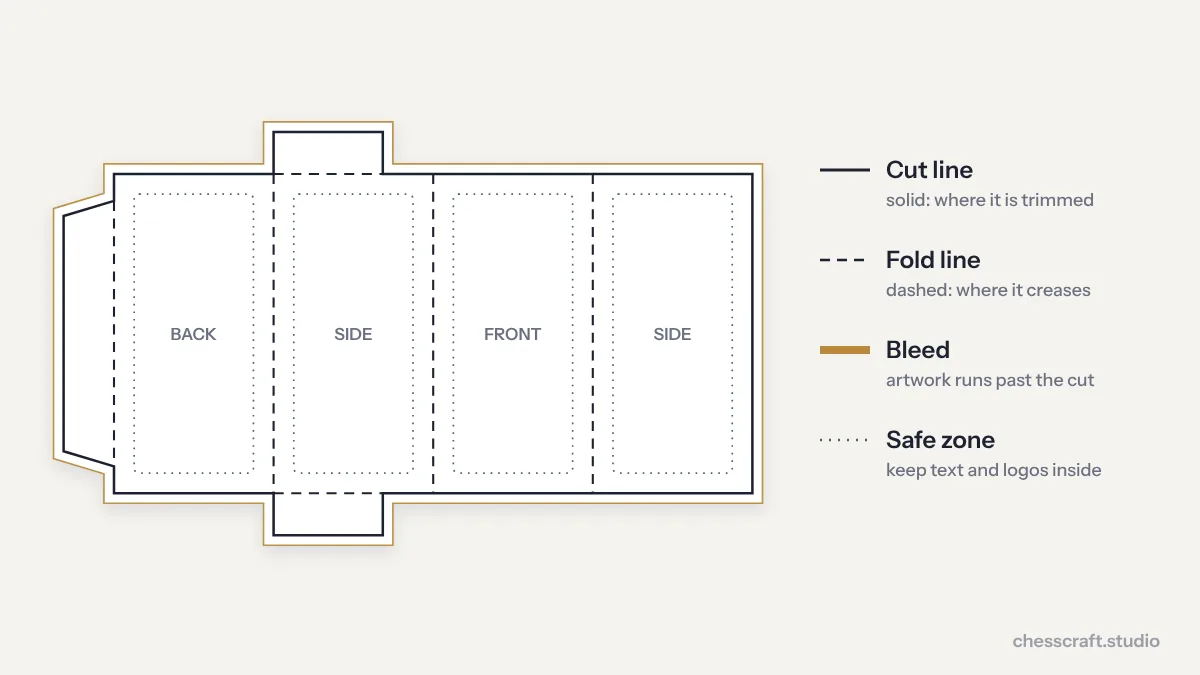
Cut lines are solid, fold lines are dashed, bleed sits outside the cut and the safe area sits inside it.
Solid lines are cut by the die, dashed lines are creased and folded, the bleed area is where your background extends past the cut so no white edges show, and the safe area is where text and logos stay clear of cuts and folds. Our guide to what a dieline is and how to read one covers each line in detail, and the print-ready files checklist covers what to send your printer.
Frequently asked questions
What is a dieline?
A dieline is the flat template of a package. It shows where the printer cuts (solid lines), folds (dashed lines) and how far artwork should extend past the cut (bleed).
Should I enter inner or outer dimensions?
Inner dimensions, the space your product needs. The generator adds board thickness to the panels for you.
What is the difference between reverse tuck end and straight tuck end?
On a reverse tuck end box, the top and bottom closures tuck in from opposite sides. On a straight tuck end box, both tuck in from the same side, which keeps the front panel clean on the shelf.
What is an RSC or FEFCO 0201 box?
The regular slotted container is the standard shipping carton: four panels with top and bottom flaps of equal depth that meet in the middle. FEFCO 0427 is the popular one-piece mailer box with a tuck-in lid.
What are bleed and safe area?
Bleed is artwork that extends past the cut line so no white edges appear if the cut shifts slightly, usually 3 mm. The safe area is a margin inside each panel where you keep text and logos so they never get trimmed or folded.
Which file should I send to my printer?
Most printers prefer PDF. Die-makers and digital cutting tables often ask for DXF. Designers usually work from the SVG.
Is this dieline generator really free?
Yes. No sign-up, no watermark, no credits and no limits. Everything runs in your browser, so your designs stay private.
Can I use these dielines for commercial products?
Yes. Dielines you make are free to use for your own products and client work, with no watermark and no attribution needed.
Can I open the dieline in Illustrator or Canva?
Yes. Open the SVG or PDF in Illustrator, Affinity or Inkscape to finish your artwork. For Canva, download the PNG or PDF and upload it as a guide layer under your design.
How accurate are the dielines?
Panels are calculated from your inner dimensions and board thickness using standard allowances. Printers and die-makers use slightly different allowances, so always print and fold a test sample and confirm the dieline with your printer before production.
Is this a box template generator or a dieline maker?
Both. A box template, a dieline and a die-cut template are names for the same flat layout. The generator makes it to your size and lets you design the artwork on it.
Always print a test sample and confirm the dieline with your printer or die-maker before a full production run.
Link to this free tool
Writing a packaging guide, a resource list or a class handout? Copy a ready-made link. It's free to share and use with clients, students or your printer.